Photo courtesy Construction Specialties
Fueled by a growing student population and demand for flexible teaching spaces, design and construction in the education sector have experienced explosive growth. Compounding those factors is the aging of educational buildings; the average age of main instructional buildings in U.S. schools is 49 years.
Beyond practical requirements, districts are also prioritizing the student experience, recognizing that design aesthetics contribute to supportive learning environments, influencing mood, behavior, and well-being. As these elements converge, designers nationwide are seeking innovative solutions that address evolving needs, promote sustainability, and unite operational goals with a positive educational environment.
Driving factors
Although individual school requirements vary, several common factors are accelerating construction and renovation throughout the education landscape:
- Student restructuring—Student populations are rapidly growing in many school districts, while declining numbers in others are causing school consolidations.
- Aging infrastructure—Many schools built in the 20th century are unable to satisfy current educational needs, which are focused on modern, flexible, and high-tech learning spaces.
- Technology—A strong push for STEM education and digital learning requires significant upgrades, including new labs, better connectivity, and advanced security systems.
- Higher education expansion—Universities are investing in athletic upgrades and research facilities. For example, in 2024, the Texas A&M University System’s Board of Regents approved more than half a billion dollars in construction projects that supported “everything from space exploration to national defense to people’s beloved pets.”
While some schools address constraints through new construction, a recent trend is to modernize existing buildings. Rising costs and urgent demands, weighed against available funding, are increasing the momentum toward renovation and repurposing, offering a cost-effective approach while maintaining the character of existing schools.
Modernizing Hutto
In Central Texas, the Hutto Independent School District (ISD) was facing the growing pains of rapid expansion. In less than a decade, it had grown by almost 30 percent, and a comprehensive review revealed its facilities were reaching full capacity.
Hutto ISD took a preemptive approach, creating a long-term facilities planning committee to assess current conditions and create a plan for the district’s future needs. Deciding upon a dual strategy, the plan combined major renovations and new school construction. Soon after, residents passed two school bonds in 2019 and 2023 for facility improvements, expansions, and compliance.
Funds from the 2019 bond launched the campus-wide modernization of Hutto High School, with a projected cost of almost $61 million. Addressing rapid student growth, the multi-phase renovation focused on delivering a flexible, contemporary learning environment and enhanced spaces for STEM, fine arts, and career and technical education (CTE).
The design process
As part of Phase III of the 2019 bond, the district developed a unique concept to showcase the school mascot as an integral architectural element on the high school facade. Desiring a 3D feature that could be viewed from multiple perspectives, the district’s vision had merit but needed a concrete plan to bring it to reality. From the outset, builders were unclear about what was being constructed, much less how to build it. Equipped with a single graphic concept and little else, the manufacturer’s facade design team began exploring options to create the architectural feature.
The design process unfolded in multiple phases. Without established plans to direct them, the team chose a starting point and moved forward iteratively. The first step was to assess the pros and cons of different products.
“At the beginning of the design process, all we really started with was a mascot graphic loosely layered onto metal staves on the building in the shape of a fin. The concept was very abstract, and we needed to consider a range of possible product solutions,” says James Clayton, architectural representative at Construction Specialties. “This process evolved. Initially, we considered vertical airfoil blades, but then we moved to rectangular fins. We later added perforation to the mix.”
The team considered airfoil blades, which would provide clean, strong vertical lines to the facade, offering a traditional louver or sunshade appearance. The individual, extruded aluminum blades offer an aerodynamic, wing-like shape. They effectively block heat and glare while allowing for open, unobstructed views between the blades.
In the end, rectangular perforated fins emerged as the most effective option, seamlessly integrating performance with aesthetics. Fins consist of a continuous or panelized flat metal sheet with a pattern of small holes. Though it appears as a solid plane from a distance, the perforations filter light, creating a dappled effect on the building. Additionally, they allow airflow to pass through, reduce noise, and provide a greater level of privacy by making it easy to see out and difficult to see in.
The planned location for the Hutto facade was the second story of a building with a bank of windows. While both products would allow light to reach the interior, the district preferred a material that the students could see through, rather than a solid blade that would block daylighting and views to the outside. The flat plane of the perforated fin was also a deciding factor, as it would provide a more uniform surface to enhance the visual appearance of the mascot graphic rather than the convex shape of the airfoil blade system.
Special requests
After settling on the product to be used, the team turned their attention to visual and engineering considerations, as well as specific requests from the school district:
- The Hutto Hippo graphic had to be prominently featured against a designed backdrop.
- The installation had to maintain legibility from both northbound and southbound sightlines.
- The district requested the facade wrap around the corner of the building without interruption.
Each factor required careful consideration and a flexible design process, along with close collaboration among designers, engineers, and manufacturers to ensure the final solution met both aesthetic goals and structural requirements.
Hippo nation
The complexity of designing visual variables for a large metal facade meant that elements that appeared straightforward, such as typography, required careful evaluation. The school district provided the design team with a graphic showing their initial idea: an image of a hippo and the words “Hippo Nation” in the district’s brand font. However, initial models revealed that the font was difficult to read.
“We landed on the right font through a process of trial and error,” says Clayton. “We would progress, and then we would realize, ‘nope, that doesn’t work.’ There was more graphics time required than anyone expected as we worked through many different iterations.”
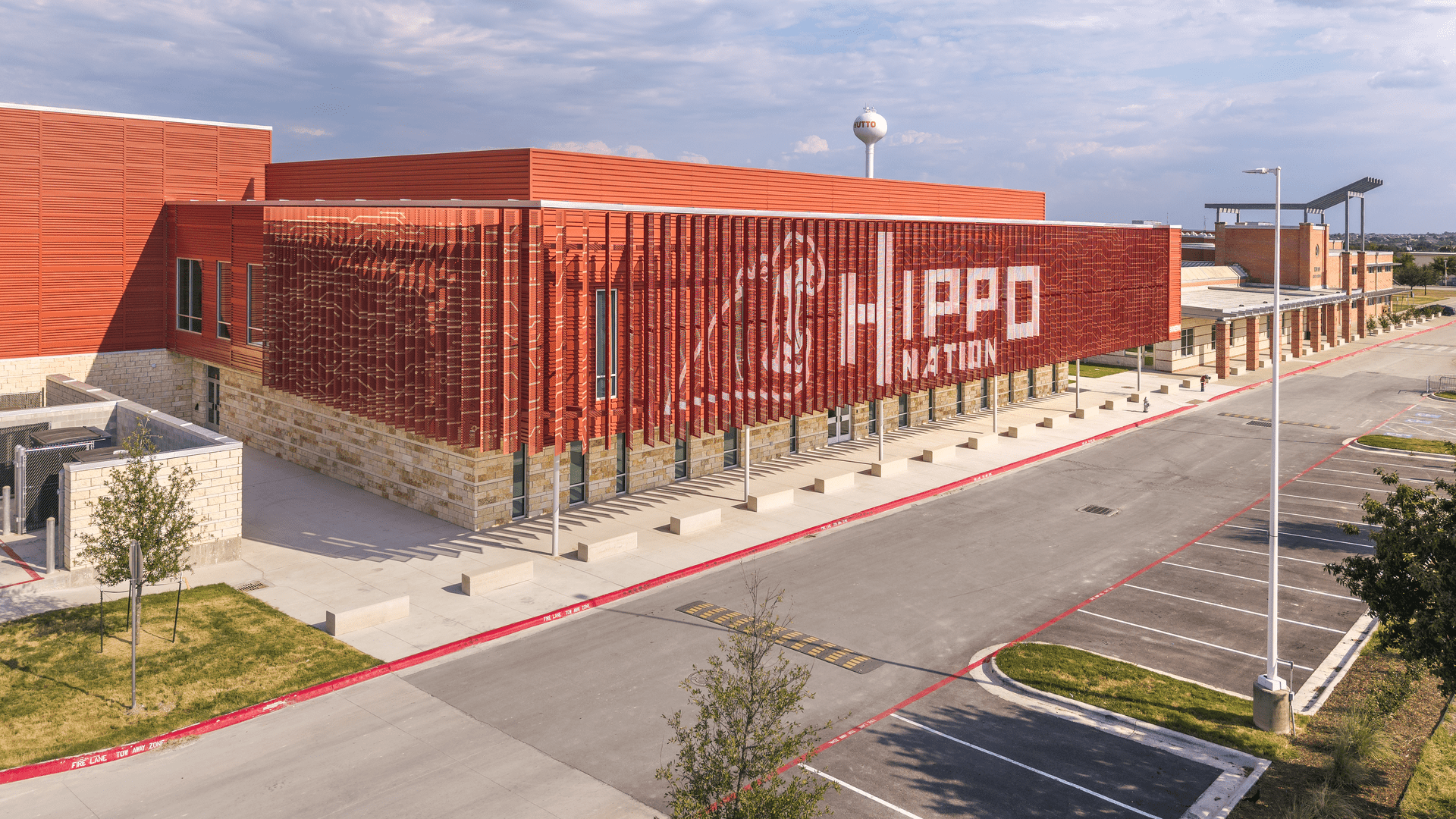
Additionally, the interaction of light with the graphic would significantly impact material properties, color values, and surface finishes, particularly given the facade’s multiple directions. A northern-facing facade receives diffused light, requiring high-contrast color or reflective elements to remain legible. A southern-facing facade will receive direct sunlight, which can wash out colors or create harsh shadows. To address these challenges, each fin was wrapped in a custom terracotta tone to match the school district’s signature color and paired with a contrasting white font. The fins are powder-coated, scratch- and fade-resistant, and AAMA 2604 compliant.
Tackling potential distortion caused by different viewing angles required careful calculations to align the graphic so it reads clearly from opposing directions. Determining the best angle required testing and on-site adjustments as the team moved around the property. Using the school drive as a point of origin, they used drone footage to view the graphic from varying heights and perspectives. After the angle was set, the team used it to determine the spacing required between the fins to keep the graphics readable. The determined distance is precise: exactly 0.6 m (1.96 ft).
Attachment styles
With only the installation to complete, the design team found the project would require persistence and flexibility to the end. Its location above a pedestrian sidewalk necessitated that torque tolerances and measurements be meticulously assessed to ensure long-term safety and performance. During calculations, the team discovered the structure was not level. Given that the frame would be anchored directly to the structure, the integrity of the design would be compromised if the blades followed the building’s slant and angled downward. To rectify the issue, the manufacturer designed a custom bracket with an elongated hole, allowing installers to adjust the panels laterally as needed to maintain level alignment.
Installation revealed another unexpected challenge. “The frame structure was fully installed and galvanized, and all the splice joints were reinforced with flat brackets and bolts,” says Clayton. “However, the brackets couldn’t be accommodated in our designs as we had planned for the fins to come all the way across. The brackets actually interfered with the design. So, to keep everything in the right place and looking correct, we redesigned the substructure to support the facade. Through this entire project, there was a lot of coordination back and forth with structural engineers and the general contractor.”
The finished product
In July 2025, the Hutto High School facade was mounted along the western front of the building, wrapping around the corner to the north facade. Spanning 41.5 m (136 ft) along the front, the installation includes a 5.5 m (18 ft) radius curve and extends an additional 13.4 m
(44 ft) along the northern side, bringing the total length to 60.4 m (198 ft). Each of the 158 fins measures 6 m (20 ft) tall and is mounted to the school with a T-bracket. The completed facade strengthens the school’s architectural presence and school spirit while standing as a lasting example of innovative design that balances aesthetics
and functionality.
Modern education approach
Hutto ISD is just one of many districts and higher education institutions across the country applying metal facades as design features. In Hayward, Calif., Chabot College Library is a modern educational facility designed to enhance both the academic experience and the campus environment. Featured prominently on the exterior of the library are solutions that include a linear sunshade system spanning the glass facade and a cantilevered trellis extending over the balcony. These elements work in unison to reduce direct sunlight while creating a visually compelling architectural presence. Through this collaboration, the library transforms from a functional space into an iconic structure, demonstrating how thoughtful design can elevate the aesthetic and environmental impact of campus buildings.
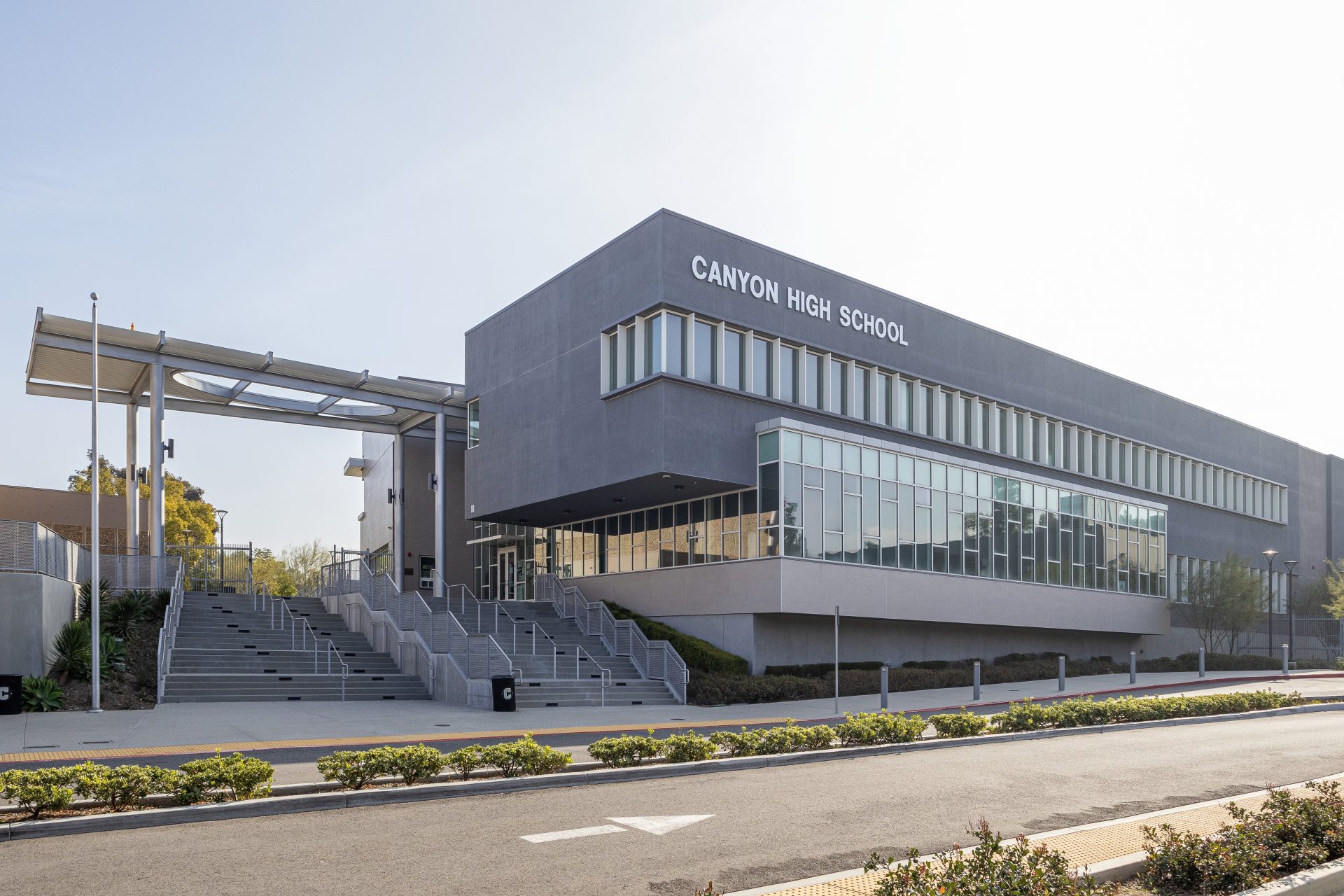
Photo courtesy Construction Specialties
In Anaheim, Calif., the new STEM Building for Canyon High School is a state-of-the-art facility designed to foster innovation and hands-on learning for the next generation of engineers and scientists. By incorporating sunshades into the design, the school reduced heat gain and glare while creating a dynamic visual element that complements the building’s sleek exterior. The controls provide essential solar protection, ensure a comfortable indoor environment for students and staff, and enhance the building’s performance and appearance.
Canyon High School’s new building provides students with an optimal environment for learning and growth. In this project, sun control provides essential solar protection while supporting its modern design. These sunshades effectively reduce heat gain and glare, ensuring a comfortable interior environment for students and staff, while adding a dynamic visual element to the building’s sleek exterior.
Located in Tonawanda, N.Y., the Tonawanda Central School District serves more than 1,800 students from pre-kindergarten through 12th grade. During a recent renovation, architects chose to install frameless sun controls to shade and enhance the elementary school. The sunshades maintain their architectural interest at night with LED lighting integrated into the blades. By looking beyond mere necessity and emphasizing beauty and visual impact, architects elevated both the school’s exterior and interior.
As construction in the education sector continues to rise, the need for creative methods that balance practical requirements with mindful solutions is also rising. Thoughtful design integrates color, light, shape, and texture to create nurturing, functional environments that augment the student experience. As more schools turn towards modernization, recognizing that functional requirements need not compromise design integrity opens the door to a wide range of architectural possibilities. Using metal facades, louvers, and sunshades is one way to significantly enhance a building’s performance while supporting a better learning environment.
Lyall Lawson is the senior product specialist of facade solutions at Construction Specialties (CS). He has more than 20 years of experience in the construction industry, building a career rooted in technical expertise with a deep focus on architectural product solutions.
This feature originally appeared in the March/April 2026 edition of Metal Architecture, which you can find in our Digital Edition Archives.