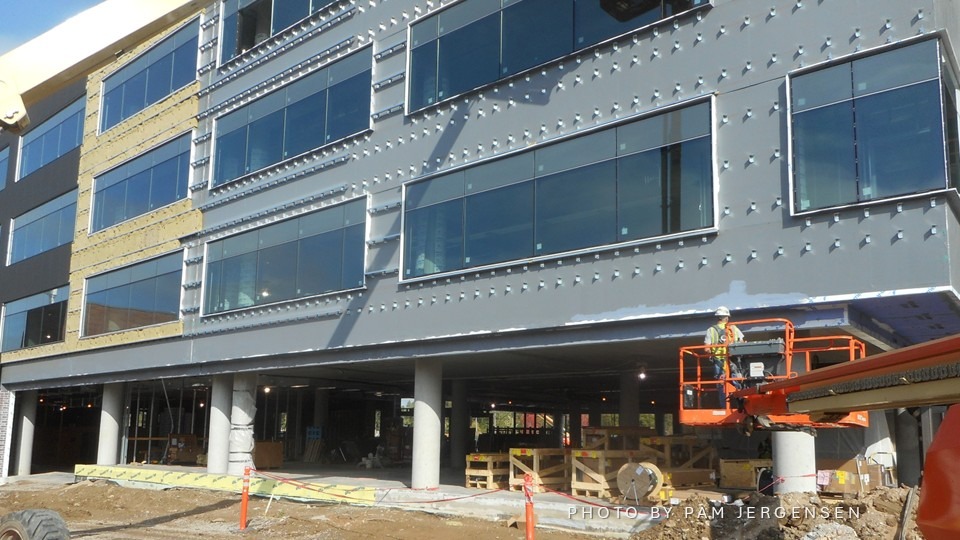
 Among building components, few are as critical and as easily overlooked as the air barrier. It rarely appears in project photos, is quickly hidden by insulation and cladding, and is often taken for granted once specified. Yet a poorly installed air barrier can undermine the performance of an otherwise high-quality building enclosure, leading to excessive energy use, condensation and moisture damage, occupant discomfort, and indoor air quality problems.
For this reason, building codes and voluntary high-performance building standards have steadily tightened requirements related to air leakage. Today, airtightness is no longer a theoretical design intent; it must also be demonstrated in the field. For the professionals responsible for delivering the building, including architects, general contractors, and subcontractors, the air barrier has become one of the most consequential elements of enclosure performance.
From prescriptive design to verified performance
Historically, energy codes focused on prescriptive requirements, including HVAC efficiency, lighting power densities, and minimum insulation values for walls and roofs. Over time, performance modeling was introduced as an alternative compliance path, allowing teams to demonstrate energy savings on paper.
More recently, codes and standards have advanced to post-construction performance verification. This shift began with the commissioning of mechanical and lighting systems and has since expanded to building enclosures, particularly air leakage. While enclosure commissioning addresses all four control layers in enclosure assemblies (water, air, vapor, and thermal), the air barrier, a significant part of the air control layer, is increasingly important for energy efficiency and sustainability. The reason is straightforward: a leaky enclosure compromises insulation performance, increases heating and cooling loads, and introduces uncontrolled moisture and pollutants into the building.
As a result, many jurisdictions now require whole-building airtightness testing (WBAT), commonly known as blower door testing. Compliance pathways often include either field observations of the air barrier installation conducted by a qualified third-party air barrier inspector or WBAT in accordance with ASTM E779, demonstrating air leakage below a prescribed threshold, typically around 2.03 L/s·m² (0.40 cfm/sf) of enclosure area.
The challenge is not the test itself. The challenge is that by the time a building reaches substantial completion and the WBAT is performed, the air barrier is fully concealed behind insulation, finishes, and exterior cladding. Any deficiencies discovered at that point are difficult, expensive, and time-consuming to correct.
Why air barrier failures are still so common
Unlike many enclosure components, the air barrier is not installed by a single trade. Its continuity depends on the coordinated work of framers, air barrier installers, roofers, cladding and window installers, and mechanical and electrical trades. Small gaps left by one trade can negate the careful work of another.
Across hundreds of projects, two field installation issues consistently account for most air barrier failures: improper sequencing and detailing at transitions and penetrations through the air barrier after installation.
These issues occur regardless of the exterior finish, whether masonry, metal wall panels, precast, or composite systems, and are routinely encountered by general contractors and air barrier installers alike.
Sequencing and transitions: where good details go to die
From a general contractor’s perspective, sequencing exterior systems is routine site management. From a building enclosure perspective, even minor sequencing changes can have outsized consequences for air barrier continuity.
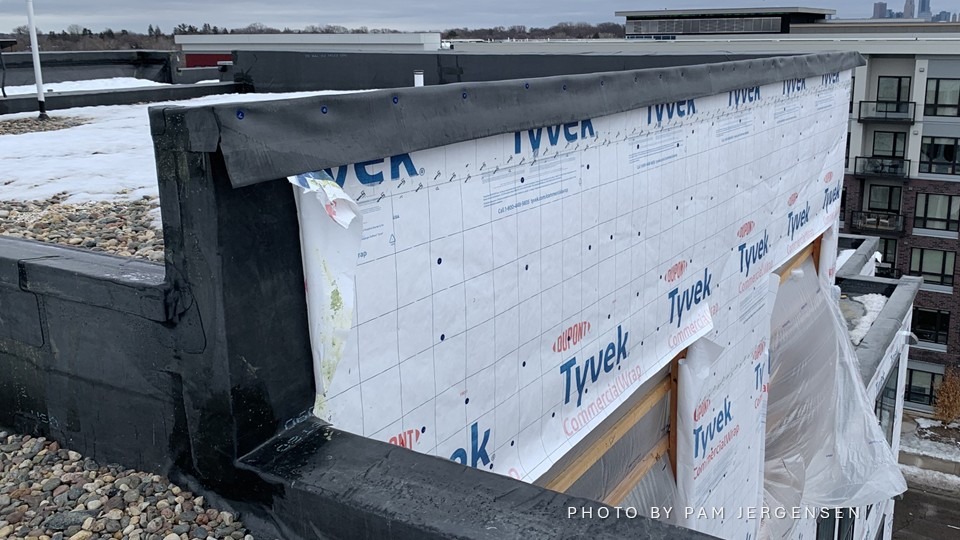
The most problematic transition, by far, is the roof-to-wall interface. Airtightness testing, enclosure forensics, and litigation history consistently show this junction to be the single most significant contributor to poor building performance. Considering that no fewer than three trades typically affect air barrier continuity at the roof edge, coordinating installation in the precise order required by the drawings is often like aiming at a moving target.
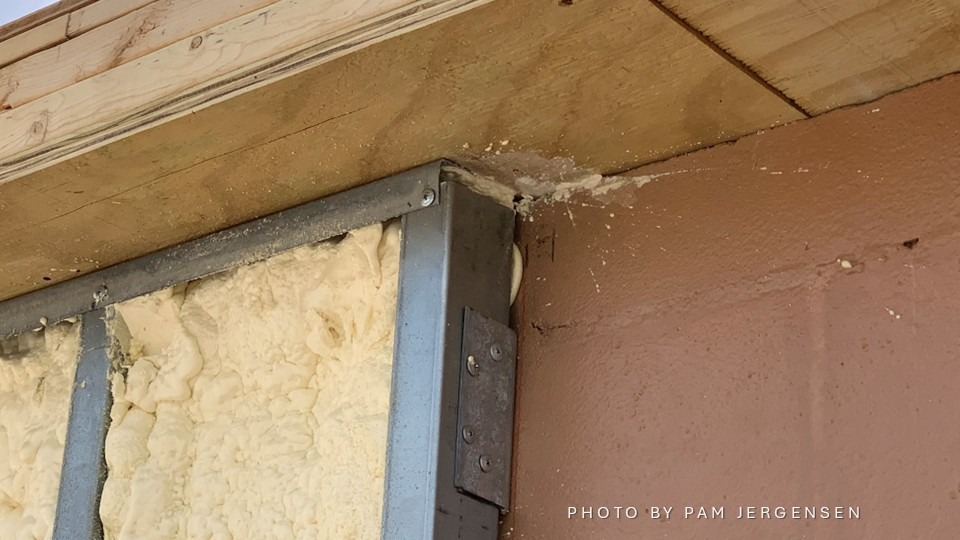
In project drawings, the roof edge detail clearly noted a self-adhered air barrier transition membrane connecting the fluid-applied wall air barrier to the roof edge wood blocking. However, steel stud framing and spray foam insulation were installed on the wall before the required transition membrane was applied, thereby interrupting continuity at this critical junction.
On an adjacent exterior elevation, clay brick masonry was installed before the self-adhered air barrier transition membrane. This required removing the newly installed masonry to properly install the transition membrane, an outcome that was less than optimal and resulted in schedule delays and added labor for multiple trades.
In buildings with complex roof geometries, multiple parapets, or stepped rooflines, roof-to-wall transitions become even more challenging. Transition material compatibility and long-term service life must be carefully considered. For example, common multifamily wall assemblies with sheathing and building wrap do not readily transition to a ballasted ethylene propylene diene monomer (EPDM) roof. Constructing a continuous air barrier system for long-term performance requires transition materials compatible with both roof and wall assemblies and with a service life aligned with adjacent exterior components.
Penetrations: small holes, big consequences
Penetrations through the air barrier after installation are another common source of failure. Conduit, piping, and mechanical penetrations often occur late in construction and can be difficult to detail properly.
As most conduit and plumbing penetrations are circular, air barrier detailing around “round things” in the otherwise square construction world remains a persistent challenge. Taking the time to properly form and install compatible transition membranes can produce excellent airtightness results, as shown in Photo 4.
The challenge increases significantly when penetrations are ganged or clustered. Limited space between pipes may prevent proper installation of the transition membrane, increasing the likelihood of air leakage, as illustrated in Photo 5.
Metal wall panel clips: a special case
Unlike many penetrations, metal wall panel clips cannot be avoided. They are installed after the air barrier and must penetrate it. Although some clips are marketed as “self-sealing,” relying solely on this feature can be risky.
The best practice during construction is to apply a bead of compatible air barrier sealant at clip fastener penetrations, providing an added level of protection at each attachment point, as shown in Photo 6.
Alternatively, sealing clip penetrations can be addressed during the design phase. Architects may specify sealing from the interior side of the wall assembly using spray foam insulation or another air barrier material within the stud cavity. This approach requires careful sequencing, installing clips before interior finishes, but can be highly effective when properly executed.
Given the sheer number of metal wall panel clips on a typical facade, even small leaks at each fastener can accumulate into a significant air leakage pathway. For quality assurance, localized depressurization testing with a small test chamber and leak-detection liquid applied at the clip attachment can confirm airtightness, as shown in Photo 7. This testing provides valuable protection against larger air leakage issues later.
Verify early
Sequencing and penetration issues are often concealed by successive enclosure layers long before substantial completion. WBAT performed at the end of construction will reveal deficiencies, but by then, corrections often require destructive, costly rework. Avoiding these outcomes requires early coordination, intentional detailing, and targeted verification during construction. Identifying and resolving issues while assemblies remain accessible protects schedules, budgets, and ultimately building performance.
Conclusion
Air barriers may be inconspicuous, but their impact on building performance is enormous. As energy codes, sustainability standards, and owner expectations continue to tighten, airtightness is no longer optional, and surprises during final testing are unacceptable.
The path forward is clear:
- Treat the air barrier as a system, not a product.
- Prioritize sequencing and transitions, especially at roof-to-wall interfaces.
- Anticipate and detail penetrations, including those for metal wall panel attachments.
- Verify performance before the enclosure is complete.
When project teams proactively address these issues, they avoid costly rework, protect construction schedules, and deliver buildings that perform as intended for decades. Ultimately, the most successful air barriers are the ones no one notices because they work.
Alan Scott, FAIA, LEED Fellow, LEED AP BD+C, O+M, WELL AP, CEM, is an architect and consultant with over 36 years of experience in sustainable building design. He is director of sustainability with Intertek Building Science Solutions.
Pam Jergenson, FCSI, CDT, CCS, CCCA, BECxP, CxA+BE, CABS, is a building enclosure commissioning professional, licensed air barrier field auditor and trained WBAT technician with over 35 years of experience. She is Technical Director for Intertek Building Science Solutions.