Image generated by AI using Gemini/courtesy Manuel E. Menchaca
The rise of Artificial Intelligence (AI) has led to an exponential demand for data centers and the numerous servers that populate them. According to McKinsey & Company, current projections estimate that global data center capacity demand could more than triple by 2030, driven largely by the expansion of AI workloads and cloud computing.
When it comes to ensuring a network is secure, protection from cyberattacks is often the first consideration; however, protection from sabotage is equally important. Physical barriers serve as a network’s first line of defense, and expanded metal offers a solution that excels at securing IT server rooms, data centers, and communications rooms by establishing a secure zone around or within a larger structure.
A network security architect designs, builds, and maintains an organization’s overall cybersecurity framework, whereas a traditional architect designs the physical barriers that prevent intrusions. For architects and designers, a fence is not just a boundary; it is an essential component of a project’s security and aesthetics.
Outside the data center, protective expanded metal fencing provides a visual solution that balances these demands with high performance and versatility. Its unique, single-piece construction eliminates the weak points often found in traditional fencing, making it exceptionally resistant to cutting, tampering, and cannot be unraveled. Its small, rigid openings restrict visibility and prevent climbing by eliminating hand and footholds.
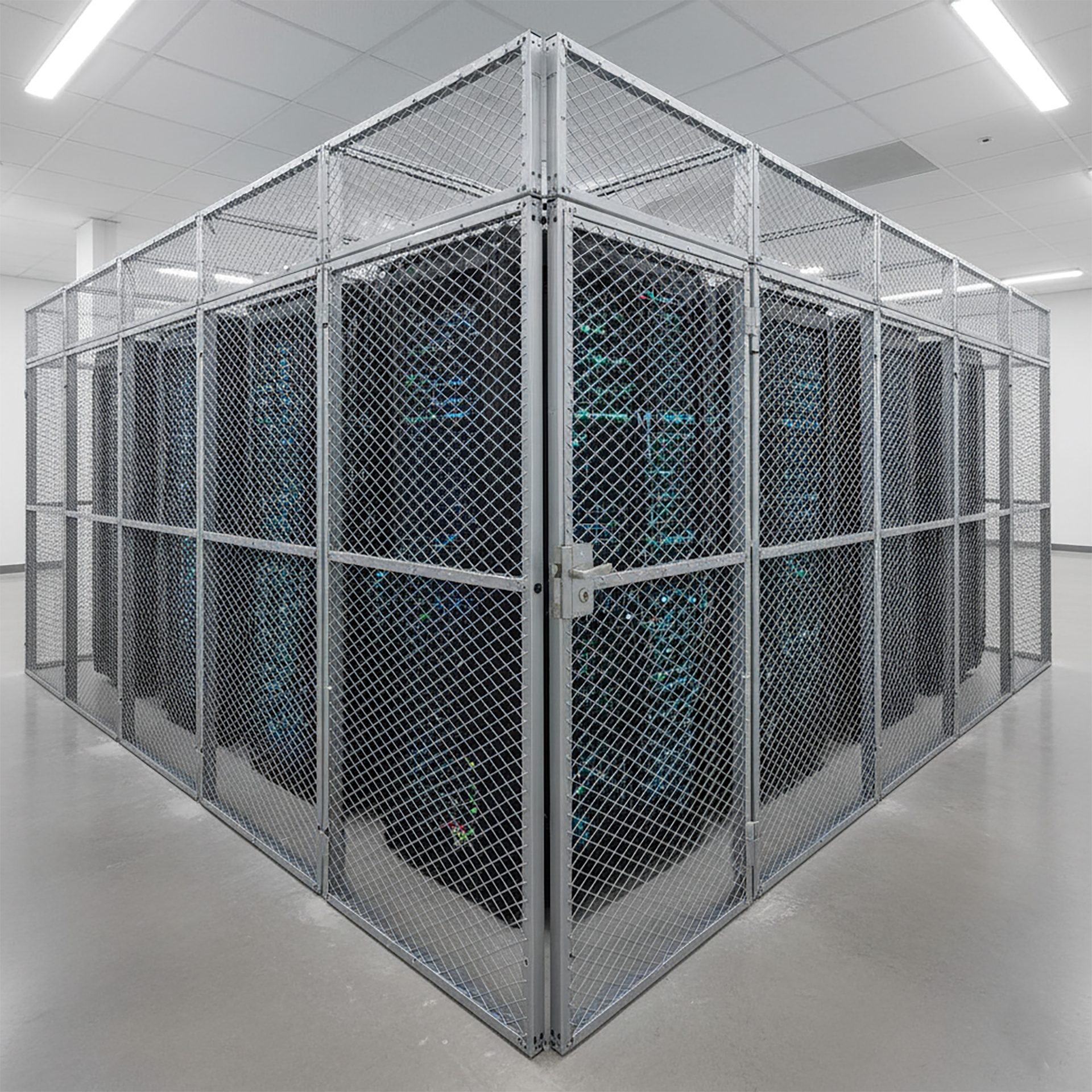
Inside the data center, secure zones can be delineated using modular expanded metal panels. Whether the perimeter has one or multiple sides, partnering with an expanded metal manufacturer provides insight and guidance for project success. Steel is recommended for its strength. The panels’ openings should be expanded from 31.8 to 38.1 mm (1.25 to 1.5 in.) along the Long Way of the Diamond (LWD), 15.9 to 19.1 mm (0.625 to 0.75 in.) along the Short Way of the Diamond (SWD), and strands measuring 1.4 mm (0.056 in.) wide. This creates a mesh that allows for non-intrusive inspection while preventing fingers from passing through.
Decorative expanded metal patterns are an excellent choice to elevate aesthetics without sacrificing performance. The metal sheets should be flattened post-expansion to provide clear sightlines for monitoring equipment. The sheets are then welded to a frame, with paint or powder coating applied before installation. This system is completed with the integration of matching framed door assemblies, ensuring a cohesive aesthetic and a continuous security threshold across the facility’s floor plan.
A single-sided assembly spans the width of the room, using the remaining walls as a solid barrier. This installation enables contactless inspection of the front of the equipment, while the back remains out of view. The panels are attached end-to-end, with a locking door providing access for servicing the equipment. The assembly is mechanically anchored to the concrete floor slab, with perimeter terminations either bolt-fastened to structural walls or held within tolerances of ±3.8 mm (±0.15 in.) to prevent unauthorized bypass. Additionally, the panels can be manufactured tall enough to be attached to the ceiling, preventing individuals from climbing over the top.
The most common assembly is a modular cage. This arrangement works especially well when the IT equipment is located in the center of the room, allowing for a 360-degree visual inspection without requiring entry into the cage. The entire cage is bolted to the floor, and the top of the cage can also be screened to create a fully enclosed, six-sided security envelope.
To protect against forced entry through a wall, flattened expanded metal sheets can be attached to the wall studs. When the walls are finished with drywall, the mesh is concealed, creating an additional formidable barrier.
Expanded metal also allows for effective ventilation and cooling. IT equipment generates significant heat. Some server cabinets have locking front doors with solid acrylic panels. Although this allows for a visual inspection of the equipment, the heat that is generated can only escape through the back. This may lead to overheating and premature failure. The material’s open mesh architecture mitigates this risk by facilitating passive ventilation and multidirectional airflow around equipment.
Consistent quality and sizing are dependent on expanded metal manufacturers, and research is required in the specifying stage to provide architects with confidence that the material will perform as desired, regardless of the application. This combination of form, function, and green building principles establishes expanded metal as a valuable tool that is more than just a facade solution. It empowers architects to push design boundaries—from perimeter fencing to high-security environments—expanded metal delivers form, function, and environmental responsibility in a single, versatile material.
Manuel E. Menchaca, MBA, is the senior marketing manager for Wallner Expac, a leading manufacturer of custom-designed expanded metals for architecture, construction, and the world’s largest manufacturer of expanded metals for HVAC filters. For more information or to request samples, visit www.expac.com.