Perforated and expanded metals have become increasingly valuable tools for architects, striking a balance between aesthetics, environmental performance, durability, and cost efficiency. While these materials have long served utilitarian roles, such as screens and protective enclosures, their capabilities have expanded significantly with advances in digital fabrication and modeling. Perforated metals now offer opportunities to control light, air, visibility, shading, and security while delivering long service life and reliable performance in demanding exterior environments.
This article examines the functional benefits of perforated and expanded metal systems, the principles that guide their design and fabrication, and strategies for integrating them into the building envelope.
Longevity and lifecycle performance
Perforated metals offer predictable, long-term durability in exterior applications. Aluminum resists corrosion even if its finish is compromised. Weathering steel develops a controlled patina that protects the underlying metal, providing a unique aesthetic. Stainless steel maintains reliable performance in highly corrosive environments. These materials do not delaminate or peel and rarely require refinishing during their service life.
Their longevity is a primary reason architects use them in exposed environments such as parking structures, exterior circulation paths, and mechanical enclosures. A long service life also reduces replacement frequency, lowering embodied carbon over the lifecycle of a building component.
Opportunities for customization
The ability to laser cut, perforate, and fold metal panels enables a high degree of customization without the tooling complexity associated with other materials. Designers can specify a wide range of open area percentages, perforation shapes and spacing, gradients or density shifts, panel geometries, folded edges for rigidity, and attachment strategies.
This level of control enables perforated metal to fulfill multiple roles simultaneously, from solar screening and visual privacy to ventilation and safety.
Functional benefits and applications
Parking structures: airflow and screening
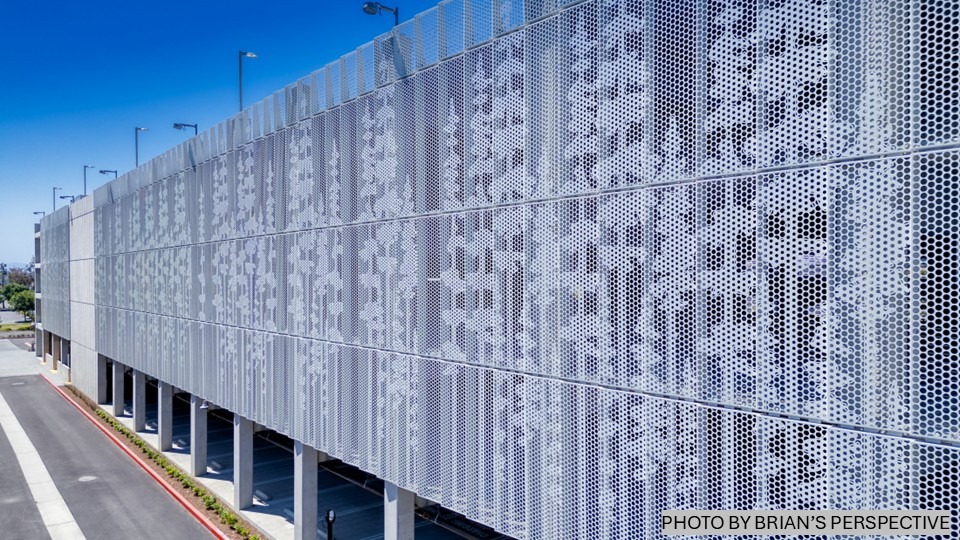
Perforated metal solutions are widely used in parking structures where building codes often require a minimum percentage of open area for ventilation. Perforation patterns allow designers to meet airflow requirements while minimizing the visibility of vehicles from surrounding streets. In some cases, pattern density is increased at street level to limit views into the garage, then decreased above for improved ventilation.
Screens can also mitigate headlight glare, manage solar heat gain, and introduce opportunities for patterning or storytelling on an otherwise utilitarian building type. Since ventilation is achieved through passive means, mechanical systems can sometimes be reduced or eliminated, thereby lowering both the initial cost and operational energy use.
At 200 Twin Dolphin in San Francisco, BDE Architecture’s designs, constructed by Truebeck Construction, used perforated aluminum panels in the parking structure to satisfy passive ventilation requirements while addressing visual concerns. The design team calibrated perforation density to shield views of the interior from the street while maintaining airflow. The panels also helped diffuse headlight glare and contributed to the facade’s overall aesthetic. This project demonstrates how perforated systems can strike a balance between performance and urban integration.
Multifamily housing: safety, transparency, and durability
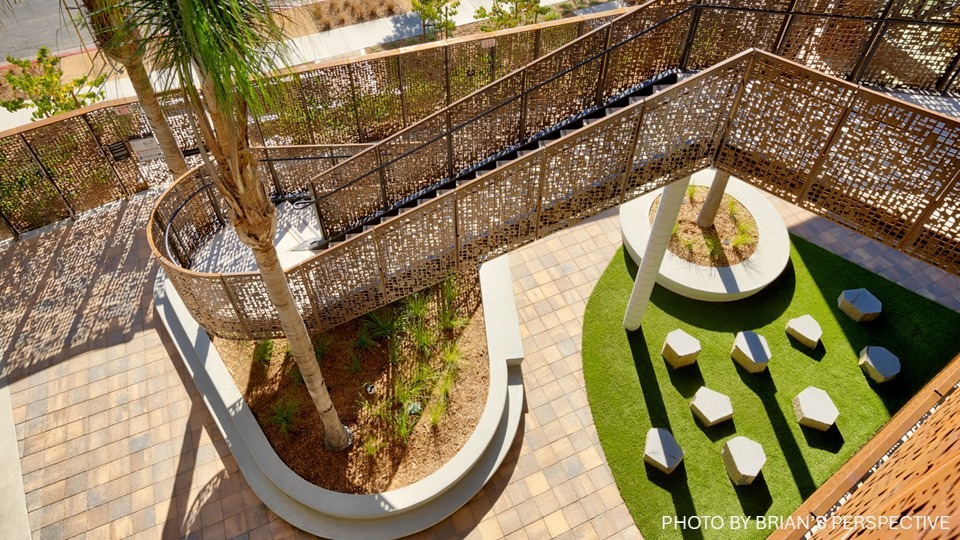
Exterior circulation systems in multifamily buildings often require materials that balance resident safety, comfort, and visibility. Perforated metal guardrails can satisfy code requirements for fall protection while allowing air movement and daylight. When used in corridors, bridges, and stair towers, perforated panels create a protected environment that still feels open and inviting.
In housing developments with limited maintenance budgets, perforated systems provide long-term resilience. Scratches on weathering steel can blend back into the patina, and aluminum’s corrosion resistance ensures that minor surface wear does not affect structural integrity. This stability makes perforated systems well-suited for facilities with high foot traffic.
The Lillian Murphy housing development, designed by Paulett Taggart Architects and erected by Cahill Contractors, uses perforated aluminum guardrails throughout exterior corridors and balconies. The perforation pattern meets safety requirements, provides daylight permeability, and allows air movement in warm conditions. The metal’s resistance to corrosion and abrasion makes it suitable for high-traffic environments. The system supports long-term durability with minimal upkeep, an important consideration for housing developments with tight maintenance budgets.
Lightweight security enclosures
In applications where security is a concern, perforated metal can obscure views of interior spaces without creating a sense of enclosure. Custom perforation densities allow clear lines of sight for occupants while reducing visibility from outside, improving safety without relying on opaque barriers. Since panels can be shaped or folded, they can span larger distances with reduced support framing, making them efficient for retrofits or tight urban sites.
The 900 Innes community facility is situated in a neighborhood where enhanced security was deemed necessary. The design team developed a perforation pattern inspired by the geometry of boat hulls. The pattern obscures views into the building while preserving visibility outward for occupants. This approach combines safety, daylighting, and contextual expression in a single system.
Calibrating open area and airflow
The open area percentage is one of the most critical performance parameters. Selecting the right open area ensures that ventilation, shading, privacy, and security goals are met. Supportive strategies include:
- 50 percent open area for parking structures requiring passive ventilation.
- 30 to 40 percent open area for applications, balancing airflow with visual screening.
- Gradient perforations for daylight modulation or site-specific views.
Shifts in perforation density can also reinforce architectural rhythm or respond to local environmental conditions.
Using folds to increase stiffness
Metal panels gain significant rigidity when edges are folded. A folded perimeter can transform a thin sheet into a stiff panel capable of spanning long distances without secondary framing. This reduces material use, simplifies installation, and limits the number of penetrations through the building envelope.
Deep folds or intermediate bends can also add visual depth. When deployed across a facade, these folded geometries create shadows, modulate scale, and enhance dimensionality.
Integrating multiple functions into a single assembly
Perforated metal can combine several roles that might otherwise require separate building components. For example, a panel can simultaneously serve as a guardrail, ventilation screen, and shading device. Integrating these elements reduces the number of materials required, clarifies the building’s visual language, and streamlines the installation process.
A multifamily project with exterior corridors, for instance, can use one perforated panel assembly to address fall protection, airflow, and privacy. A mixed-use structure with a parking podium can integrate screening, pedestrian-level security, and pattern-based wayfinding into a single system.
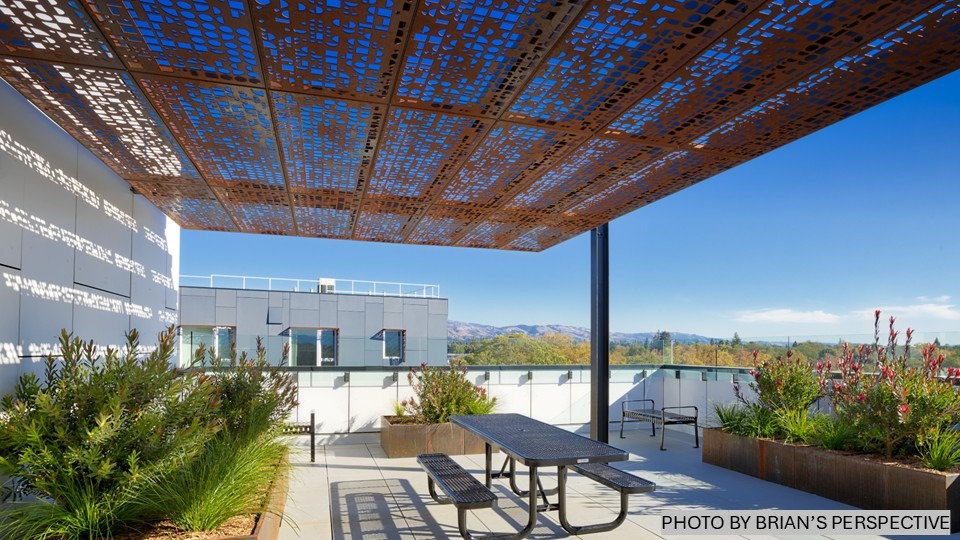
At the mixed-use development Sango Court, David Baker Architects’ design features perforated metal in sunshades, guardrails, fencing, and a rooftop trellis. The consistent use of material ties the facade and landscape elements together. The use of a single material family creates a cohesive identity for the project and prevented installation complexity for the general contractor, Nibbi Brothers.
Reflectivity, daylight, and shading
The reflectance of the metal surface influences daylight performance. Light-colored aluminum reflects significant amounts of sunlight, which can brighten shaded walkways or reduce heat buildup. Weathering steel provides a matte, absorptive surface that eliminates glare. Designers can tune shading performance by adjusting perforation size and orientation, providing precise control over solar exposure.
At night, designers can add backlighting to perforated metals for visual interest.
Accommodating graffiti, wear, and vandalism
In high-traffic areas, perforated metal provides practical advantages. Graffiti on weathering steel can be removed through sanding, and the patina will reform, blending with the repaired surface. Aluminum resists corrosion even when scratched, ensuring that vandalism does not lead to component failure.
Cost considerations
Perforated metal often compares favorably to other facade materials when evaluated on a lifecycle cost basis. Several factors contribute to cost efficiency:
- Laser cutting and brake forming require relatively simple
fabrication processes. - Panels can be optimized for sheet yield, reducing waste.
- Folded panels can replace heavier structural systems.
- Installation is streamlined due to reduced framing requirements.
- Maintenance needs are minimal over the product lifecycle.
These efficiencies make perforated metals suitable for both budget-constrained projects and those requiring long-term durability.
Environmental performance and sustainability
Metal can be recycled repeatedly without degrading its structural properties. Perforated systems are typically composed of a single material, which simplifies end-of-life recycling. This supports circularity goals and aligns with broader environmental criteria now common in institutional and public projects.
Materials with a long service life reduce the frequency of replacement, thereby lowering the overall embodied carbon over the life of a building. Since perforated metal systems resist UV degradation, corrosion, peeling, and delamination, their durability directly contributes to sustainable lifecycle performance.
Design trends and emerging directions
Several trends are shaping the use of perforated and expanded metal in contemporary architecture:
- panels with large-format perforations or irregular geometries
- gradient patterns that shift openness across a facade
- integration of lighting to animate perforated elements at night
- multi-layer assemblies that create depth and changing opacity
- expanded metal meshes that combine strength with transparency
As digital fabrication becomes more accessible, designers are exploring perforations as a medium for storytelling, environmental response, and cultural expression.
Perforated and expanded metals provide designers with adaptable solutions for addressing airflow, shading, durability, and visual identity. Their flexibility comes not only from the shape of the perforations but also from the ways they can be folded, structured, and integrated into larger facade assemblies. As buildings are increasingly expected to achieve high performance with fewer resources, perforated metal offers a balance of efficiency and longevity while maintaining design intent.
In practice, these systems deliver clarity and utility. They respond to functional requirements while supporting design intent, offering solutions that adapt as surfaces weather or light conditions change. For architects seeking dependable and flexible materials, perforated metal remains a compelling choice.
Russ Naylor is an architect and co-founder of BŌK Modern, a company specializing in integrated metal solutions for building envelopes, landscapes, and beyond. His work integrates structural efficiency, digital fabrication, and material longevity into facade and site design. He collaborates with architects across the U.S. to develop innovative metal solutions.